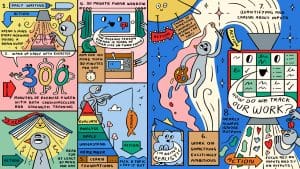
In the movie Limitless, there is a pill that Bradley Cooper takes to “access” 100% of his brain, allowing him to rule the world, make fat bills, and change his life. Do we actually only use 10% of our brains? Well… no.
In reality, evolution has made our body extremely efficient. Why would it support, build, and grow the most calorie hungry organ in our body, our brain, if we weren’t going to use all of it.1
In actuality, we use most of our brain, most of our time.
However, we can change the relative composition and structure of our brain. We can literally alter the size of certain parts of our brain based on what we do. Maybe we could change the allocation from 10% stress and 10% productivity, to 18% productivity and 2% stress.2
The brain is plastic, which means as certain neurons get more chemicals, like dopamine, they will grow more and connect to more things and create new thoughts and insights with actual physical changes in the 86 billion neurons in your brain.
And, not only that, this isn’t a zero sum game. We can grow certain parts of the brain because the brain is plastic, which means, like our muscles they can be molded. So not only can you grow your brain biceps, but you could grow your brain quads without taking away from your brain pecs.
What is something that you learned and got much better at? For me, in college, I remember this vividly with organic chemistry. At the beginning of the semester, I had no idea what was going on, by the end of it, I was flipping carbons and electrons like it was my job.
The “organic chemistry” part of my brain had literally grown an adapted. However, this also works the other way, now that I haven’t looked at a carbon bond in 10 years, that part of my brain has shrunken away and if I tried it again my skills would be week.
That’s why, the most magical thing of all, is cultivating the ability to learn efficiently and effectively. When you do this. Nothing can stop you. No tough class in school. No difficult problem at work. No rabies-ridden squirrels.
Ok maybe the squirrels.
But, if I had to pick one skill that has changed my life the most? Easily, without question, is the ability to learn well. Becoming a doctor, starting a YouTube channel, and learning how to summon creatures of nature.
Working out, memory, social interactions, hobbies, making money, creating online content, writing, reading, the list goes on… If I can learn well I can do anything.
And the better I get at it, the better it improves all aspects of my life.
When you can learn anything you can do anything.
This is the limitless pill. Giving your brain the food and exercise to grow it just like a muscle and certain parts will get bigger and stronger, and help you do more mentally difficult tasks. When you have the ability to learn anything, you have the ability to do anything. You have the ability to become limitless.
In this video, I’m going to show you how to level up your brain by growing the most important muscle of all, the brain-muscle of learning. All based on academic evidence. By the end of it, you’ll know exactly how to start exercising your brain and transforming it to become a limitless powerhouse.
If you don’t know me my name is Zach and I was a doctor, but now am a life sciences consultant living in NYC.
First we will start with identifying the parts of your brain you want to grow with “Why,” then putting training wheels on the pre-frontal cortex, then finally making those parts of the brain so strong, they have abs, on their abs.
1. Figure out the part of your brain to grow with “Why”
Which part of your brain do you want to grow?
This is the biggest trick and most important trick, how will you use this information, and these newfound brain abilities? This is 50% of the limitless pill.
If you know the reason you are growing this part of your brain you become unstoppable.
- Viktor Frankl attributes knowing his “why” to surviving Nazi Concentration Camps. He wanted to be reunited with is wife and finish his manuscript. He built survival and resilience pathways in his brain through his “why.”
- Malala Yousafzai believed so much in the education of girls that even after being shot by the Taliban for her advocacy and being in a constant, very real, fear for her life, she continued to work for the education of girls. Her brain molded to help her accomplish her “why.” She learned multiple languages, started schools, and became the youngest Nobel Prize laureate ever.
Yes these stories are cool, but what about us normies? What if you just want to build a cool computer program? Learn about space? Or become a doctor?
Well, that’s perfectly fine, the only thing you need to do, according to evidence3, is figure out why you want to do those things? Where’s the intrinsic motivation?
Emotional engagement can cause differences of learning up to 82%. Research by Gallup highlights that schools with high emotional engagement create a fundamentally better learning environment. When compared to schools with the least engaged students, those in the top quartile of emotional engagement were 50% more likely to be above average in reading and 82% more likely to be above average in math (Gallup, as cited by Walden University, n.d.). This powerful data underscores that a strong emotional connection to learning—whether for an individual or a whole school—is a critical predictor of high performance.
A major 2018 meta-analysis covering over one million students, which found that those participating in social-emotional learning (SEL) programs scored an average of 11 percentile points higher in academic achievement than their peers who did not (Mahoney, Durlak, & Weissberg, 2018). This shows a direct, measurable link between developed emotional skills and superior academic outcomes.
Similarly as powerful, and similar in many ways to emotional engagement, is autonomous motivation. The research emphasizes the key difference between autonomous motivation (intrinsic), or motivation truly coming from you, your sense of values, and your excitement, vs controlled motivation (extrinsic), that comes from aiming for an outcome or reward like a grade or money.
One study that looked at 383 medical students in Amsterdam found that those students with autonomous motivation were more likely to have better study strategies (deep learning vs. surface learning), study effort, and GPA.4
- So if you want to build a cool computer program, maybe your “why” is to make it easier for startups and developers to accept payment online so they can grow their business and change the world (that was the founder of Stripes “why.”)
- Maybe for learning about space, you want to expand the human race beyond Earth (this is Elon Musk’s “why” for SpaceX).
- Maybe you want to become a doctor to stop awful suffering you have seen in the world or in your own family (Jonas Salk initially went into medicine for stability and respect, but later changed the world of medicine after witnessing the devastating polio epidemic, eventually making the polio vaccine).
Action: develop your personal mission statement.
Which part of your brain do you want to shrink?
Now, most of us are very busy with school, family, or just other random life things. My fort against the squirrels is nearly complete.
In order to grow this new part of your brain, to accomplish these amazing things, we may need to shrink another part of our brain. However, 9 times out of 10, we don’t have to shrink a part of our brain that we like, we can shrink a part of our brain that we don’t like.
For me, for example, this was as simple as spending less time on my phone. Scrolling Instagram. Watching TV. Playing video games. These were parts of my brain that grew because I fed them with more and more dopamine.
And just like brain neuroplasticity, that is growing and changing or shrinking certain parts of the brain from different activities, can work in a positive way like learning programming, it can work in a negative way like smart phone addiction. There is much more evidence now that as we consume certain media, this releases dopamine, which the brain is built to hunt for. And this positive feedback loop is hard to break from. Here’s a quote from Frontiers in Psychology:
The prefrontal cortex is responsible for high-level cognitive functions such as decision-making and impulse control, while the amygdala is involved in emotional processing. In the case of smartphone addiction, the excessive activation of the reward circuit leads to a decrease in the prefrontal cortex’s ability to control impulses. At the same time, the activity of the amygdala increases, making individuals more prone to strong emotional responses and cravings for smartphone-related stimuli, and it becomes difficult for them to suppress the urge to use smartphones.
So, these pathways hijack our thinking part of the brain (our prefrontal cortex) and activate our lizard brain (the emotional amygdala).
Thankfully, the less we feed the beast the smaller it gets. For example, children that have been unfortunately mistreated as kids have larger amygdalas, however, mindfulness meditation in multiple studies has been shown to actually reduce the volume and reactivity of the amygdala. Isn’t that amazing? Activities and things we do can literally change our brain.5
Action Item: decide on one part of your brain you want to shrink, and how you are going to do it.
Why do other people care about this thing? Who are your mentors or guiding forces?
Finally, the road is never easy or straight. There will be potholes, speedbumbs, detours, and, of course, rabid squirrels.
Who do you look up to? Why do people care about this thing? Can they help you define and hang onto your personal mission statement?
There are likely people who have walked the path before you, you do not need to re-invent the wheel. What issues did they run into? Why did they do what they did? How to they overcome their challenges?
These don’t have to be famous people. I look up to my grandpa, mom, and dad for various reasons. I also look up to many of the doctors I met when I was becoming one. I also look up to Gordon Ramsay, Howard Stern, and Marcus Aurelius.
Action Item: Really learn about one of your mentors or people you aspire to be like, maybe read their biography if there is one, then, when you run into challenges, because you will, think, What would X do?
Ok, so from step 1 we are going to:
- Figure out why we want to grow our abilities in a certain area (and our brain) by developing our personal mission statement
- Figure out what we want to reduce in our brain (and how) by eliminating that activity from our life as much as we can
- Identify one mentor or hero to look up to, and when we face a struggle we can think, “What would X do?”
2. Achieve 85% Competency of Beginner Materials
In the Karate Kid, Mr. Miyagi teaches Daniel “wax on, wax off.” Daniel is annoyed because he wants to learn to kick and punch. Only later, when Daniel has his first practice session with Mr. Miyagi, does Daniel realize how important that stuff was to learn and how spot on Mr. Miyagi was. Before Daniel can kick and punch he needs to learn balance, strength, and form.
There is an optimal zone of learning that seems to be the same among mice, monkeys, humans, and even computer algorithms, and that zone according to Nature and multiple repeated studies is 85%. More specifically the optimal error rate seems to be 15.87%.
If the difficulty is too high and learners get 20, 30, or 50% of the questions wrong it takes longer and more effort and resources to train learners. If the error rate is too low learners find the experience too easy and are bored and they don’t have a big enough gap of information to find things to learn.6
Duolingo adjusts the difficulty of their exercises to hit 80-85% success rates.
So, here’s how to get to 85% competency so you can crane kick the bad guy and change your life.
Magazine the topic
I remember in my AP psychology class in high school I’d stare at the first paragraph of the textbook for 10 minutes and get nowhere. The words were so difficult and I had no idea what the point of the intro paragraph was.
I closed the book and stopped studying.
I came back later that day and instead of trying to read it, I just flipped the pages. Looking at the nice pictures and bolded text and only reading what was interesting to me. Just like I would read a magazine.
It gave me an overview of the chapter I was reading, an outline of what I could expect as I moved through the topic, and a small bit of excitement as I naturally was drawn towards the parts of the textbook that interested me.
To this day, I find this one of the best ways to start learning about a topic. If I am reading a book, or looking at a powerpoint, or going on a trip to a new country, I’ll flip through all the information randomly; flipping the pages, clicking through a powerpoint without reading anything, or looking at pictures randomly on google of this new place.
But, my absolute favorite way to do this, is YouTube videos. “Beginner” YouTube videos are not only interesting, but they are accessible and to the point, usually summarizing a potentially semester long topic in a couple of minutes!
This builds the momentum for me to keep going and starts to build me closer to my magic 85% number.
Understand vocab, grammar, and terms, keep a simple notebook page of the basic information
The next step is making sure I understand the terms that I encounter when reading or going through the learning. Again, the goal here is to get to 85% competency.
Read this sentence:
Mitochondria est fons potentiae cellulae – do you understand it? I don’t. I just put “mitochondria is the powerhouse of the cell” into google translate to latin. I understand less than 20% of the words their which makes that sentence pretty much useless for me.
Now try this sentence:
Epitaxially grow heterostructures via MBE, pattern via EUV lithography and RIE, implant dopants with RTA, then deposit gate stacks and silicide ohmic contacts.
Do you know what this sentence is describing? I wouldn’t, I just asked Claude to tell me the steps of building a semiconductor like I was an expert.
Now, I googled “epitaxially, MBE, EUV lithography, RIE, dopants, RTA, gate stacks, and silicide ohmic contacts” and then the sentence made sense (well, a little more sense…).
Now, likely, in your class or whatever you are learning about, there is a set of basic words and phrases that are essential to understand the basics of what you are learning.
- When I was learning Spanish and Italian I memorized my most used 100 words and it helped me so much.
- When I was learning from a textbook in school, I’d find the bolded words and make sure I understood what they meant.
- When I started to learn programming I made sure to first learn what front-end and back-end meant, what functions and loops meant, what Java, C++, node.js, Python, HTML, CSS, and other random things meant.
Cultivate a Growth Mindset
Finally, importantly, even when I get a general overview and learn the basic terms, some things are going to be hard, maybe even beyond the the 15% difficulty level we are aiming for (you can test this with practice test sets, flashcard sets, and standard times of completing certain tasks. As you progress you’ll get a good sense of what this rate is).
So what do you I when things seem really hard? I remember my “why” and remember I can figure pretty much anything out it’s just a matter of time. Maybe I need to watch a beginner YouTube video again, maybe I need to completely restart from where I was two weeks ago, or maybe I need to reach out for help.
This is where most people give up which is no bueno because this is where the opportunity is for the biggest change! This is your personal barrier, and, so, when you do break through it, it not only teaches you something new, but builds your confidence for the next time you face something very difficult.
Then, when you get to 85%? Now things start becoming awesome. Now we start solving problems on our own.
3. Solve NEW Problems On Your Own
When you can solve new problems on your own, you are truly unstoppable. This is the other 40% of the Limitless Pill (50% why, 10% get to 85% difficulty, 40% solving new problems on your own).
The biggest thing I took from my engineering degree in college, was learning that it’s possible to solve unsolved questions on my own. Questions even my professors don’t know the answer too. For example, my team in college was building a Circadian Rhythm Monitor and Jet Lag Avoidance System, but we had no idea how to measure body temperature and connect it to an Android application.
Using public NASA documents, PubMed articles, and my electrical engineering colleagues, we developed an algorithm that converted a temperature sensors information to electrical information that then charted the subjects body temperature overtime to accurately (within 1 degree accuracy) measure their temperature.
Doing this I learned insane amounts about the human body, circadian rhythms, and electrical engineering. I still use a lot of that information today in my YouTube videos!
Solving new problems is not only exciting, it’s the fastest way to learn.
Get organized, set SMART GOALS
Now that you know why you are learning what you are learning, are at 85% competency, things get great. What are you going to accomplish? What are you going to do? What are you going to build or change?
The evidence-based way to do this is with something called “SMART” goals. Simply, this means specific, measurable, achievable, relevant, and time-bound. To me, this means what will you accomplish over what time period?
For example, I wanted to learn programming. But that is not specific enough. After going through the previous steps, I realized I wanted to learn programming because I wanted to be able to build things on my own and solve problems from beginning to end specifically with web apps and eventually in the medical or education space to help people save time or learn things more easily.
So, I arranged monthly goals of finishing certain projects, with steps of each project throughout. These were projects never done before but I knew the exact programming language, where I would learn the materials, and what a somewhat final product might look like.
In medical school, this was a certain amount of flashcards or practice questions completed in one day.
When I was learning Italian, I wanted to be able to hold a conversation for two minutes by the end of two months.
Action Item: What is the problem you are solving? How are you going to solve it and within what time frame? The more specific the better.
Test yourself and be honest with yourself, make it challenging!
The biggest mistake is playing yourself. When I first started studying flashcards I just flipped them and read the answer and thought that was “doing the flaschard.” It wasn’t! I wasn’t really testing myself, I was play-along studying. And my scores reflected this.
There are things that are much easier for other people and harder for me, like dancing. I’m awful. Then there are things that are easier for me and harder for other people, like making YouTube videos.
I know, that if I want to be good at dancing, I need to put in a lot of work and start from the beginning.
In order to continuously improve, I need to make sure things aren’t too easy or too hard, that I am hitting that 85% rate. A huge ego-hit for me was when I had to drop down a language-level class because it was too difficult for me and I wasn’t learning anything. That class was at about a 40% error rate for me which was too high.
Even more difficult for me is the other end, for example, these YouTube videos. I can pump out decent YouTube videos very easily, but what’s my goal? Well, my goal on YouTube is to become a better storyteller, challenge myself, learn new things, and share what I learn.
If I continue to make videos that are 99% easy for me, I’m not challenging myself, and I’m not learning. I need to do more ambitious videos, or try to learn about things I don’t understand, or something to make the process challenge me in some way to get closer to that 85% difficult if I want to learn and grow my brain at being an online content creator.
Action item: evaluate your difficulty rate as you progress, are you still at 85%? Is it too easy? Too hard? Do you feel your brain working?
Connect with others
Finally, there are unknown unknowns that you will never discover without the help of others.8,9
- Medical students who have a study group outperform equally intelligent students who study alone.
- Many tech breakthroughs come from “skunkworks,” or small-team problem-solving sessions
- MIT has its “Building 20” that has informal spaces where different faculty and students from different disciplines bump into each other. Nine Nobel Laureates has emerged from this social learning environment.
Importantly, my guess, is that many of these breakthroughs from working with others comes only after your personal work is in check.
Action item: where can you find people to work with in this area that you want to grow your brain? Try and meet with them once a week if possible.
Summary
Step 1: Figure Out Your “Why”
- ✅ Develop your personal mission statement – why do you actually want to learn this thing?
- ✅ Identify one part of your brain to shrink (probably phone scrolling, let’s be honest)
- ✅ Pick one mentor or hero to look up to – when things get hard, ask “What would X do?”
Step 2: Get to 85% Competency (Training Wheels Time)
- ✅ Magazine the topic – flip through, watch beginner YouTube videos, get the vibe
- ✅ Learn the basic vocab and terms – keep a simple notebook of the essentials
- ✅ Cultivate a growth mindset – it’s not “I can’t,” it’s “I can’t YET”
Step 3: Solve NEW Problems (Brain Abs on Brain Abs)
- ✅ Set SMART goals – what will you build/accomplish and by when?
- ✅ Test yourself honestly – are you at 85% difficulty or are you playing yourself?
- ✅ Connect with others – find your study group, your coding buddies, your learning crew
Here’s the truth: there is no magic pill. Bradley Cooper lied to us (sorry Bradley).
But there IS something better. Something you can actually do. Something that won’t wear off or give you weird side effects or require a shady prescription.
The real limitless pill is you. Your brain. Right now. Today.
Every single day, you get to choose which parts of your brain you feed and grow. You get to choose between scrolling Instagram for the 47th time or learning something that actually matters to you. You get to choose between giving up when things get hard or pushing through to that breakthrough moment when everything clicks.
And the best part? Unlike the movie, this pill doesn’t run out. The more you use it, the stronger it gets. The more you learn, the easier it becomes to learn. The more problems you solve, the better you get at solving problems.
Learning how to learn is the ultimate superpower. It’s the one skill that unlocks literally every other skill. Want to start a business? Learn it. Want to make art? Learn it. Want to finally understand what your doctor is saying? Learn it. Want to protect yourself from rabid squirrels? Well… ok maybe that’s the one thing you can’t learn.
So start today. Pick one thing. Just one. Find your why. Get to 85%. Solve a new problem.
Your brain is already limitless. You just need to start using it that way.
Now go out there and grow those brain muscles.
Work Cited
- Herculano-Houzel S. The human brain in numbers: a linearly scaled-up primate brain. Front Hum Neurosci. 2009 Nov 9;3:31. doi: 10.3389/neuro.09.031.2009. PMID: 19915731; PMCID: PMC2776484.
- Desbordes G, Negi LT, Pace TW, Wallace BA, Raison CL, Schwartz EL. Effects of mindful-attention and compassion meditation training on amygdala response to emotional stimuli in an ordinary, non-meditative state. Front Hum Neurosci. 2012 Nov 1;6:292. doi: 10.3389/fnhum.2012.00292. PMID: 23125828; PMCID: PMC3485650.
- Di Domenico SI, Ryan RM. The Emerging Neuroscience of Intrinsic Motivation: A New Frontier in Self-Determination Research. Front Hum Neurosci. 2017 Mar 24;11:145. doi: 10.3389/fnhum.2017.00145. PMID: 28392765; PMCID: PMC5364176.
- Kusurkar RA, Ten Cate TJ, Vos CM, Westers P, Croiset G. How motivation affects academic performance: a structural equation modelling analysis. Adv Health Sci Educ Theory Pract. 2013 Mar;18(1):57-69. doi: 10.1007/s10459-012-9354-3. Epub 2012 Feb 22. PMID: 22354335; PMCID: PMC3569579.
- Zhu W, Zhang Y, Lan Y, Song X. Smartphone dependence and its influence on physical and mental health. Front Psychiatry. 2025 Aug 19;16:1281841. doi: 10.3389/fpsyt.2025.1281841. PMID: 40904566; PMCID: PMC12401922.
- Joss D, Khan A, Lazar SW, Teicher MH. A pilot study on amygdala volumetric changes among young adults with childhood maltreatment histories after a mindfulness intervention. Behav Brain Res. 2021 Feb 5;399:113023. doi: 10.1016/j.bbr.2020.113023. Epub 2020 Nov 26. PMID: 33249071; PMCID: PMC7856159.
- Wilson RC, Shenhav A, Straccia M, Cohen JD. The Eighty Five Percent Rule for optimal learning. Nat Commun. 2019 Nov 5;10(1):4646. doi: 10.1038/s41467-019-12552-4. PMID: 31690723; PMCID: PMC6831579.
- De Felice S, Hamilton AFC, Ponari M, Vigliocco G. Learning from others is good, with others is better: the role of social interaction in human acquisition of new knowledge. Philos Trans R Soc Lond B Biol Sci. 2023 Feb 13;378(1870):20210357. doi: 10.1098/rstb.2021.0357. Epub 2022 Dec 26. PMID: 36571126; PMCID: PMC9791495.
- Li, P., Jeong, H. The social brain of language: grounding second language learning in social interaction. npj Sci. Learn. 5, 8 (2020). https://doi.org/10.1038/s41539-020-0068-7